

SoundQubed
SoundQubed 4400 Watt F4-4400 Full Bridge 4 Channel Amplifier
SoundQubed 4400 Watt F4-4400 Full Bridge 4 Channel Amplifier
Couldn't load pickup availability
SoundQubed 4400 Watt F4-4400 Full Bridge 4 Channel Amplifier
Sold by AudioSellerz.com
The SoundQubed 4400 Watt F4-4400 Full Bridge 4 Channel Amplifier is a SoundQubed four-channel speaker amplifier for a system built around the exact power ratings, impedance limits, channel layout, wiring, and electrical requirements listed below.
Use the model name F4-4400 when comparing SoundQubed amplifiers. Do not choose an amplifier from the largest wattage number alone; match continuous output at the intended load, the connected speakers or subwoofers, power and ground wire, fuse protection, battery support, alternator capacity, airflow, and gain settings.
Original Product Details and Specifications
SoundQubed F4-4400 4400W Full-Bridge 4-Channel Amplifier
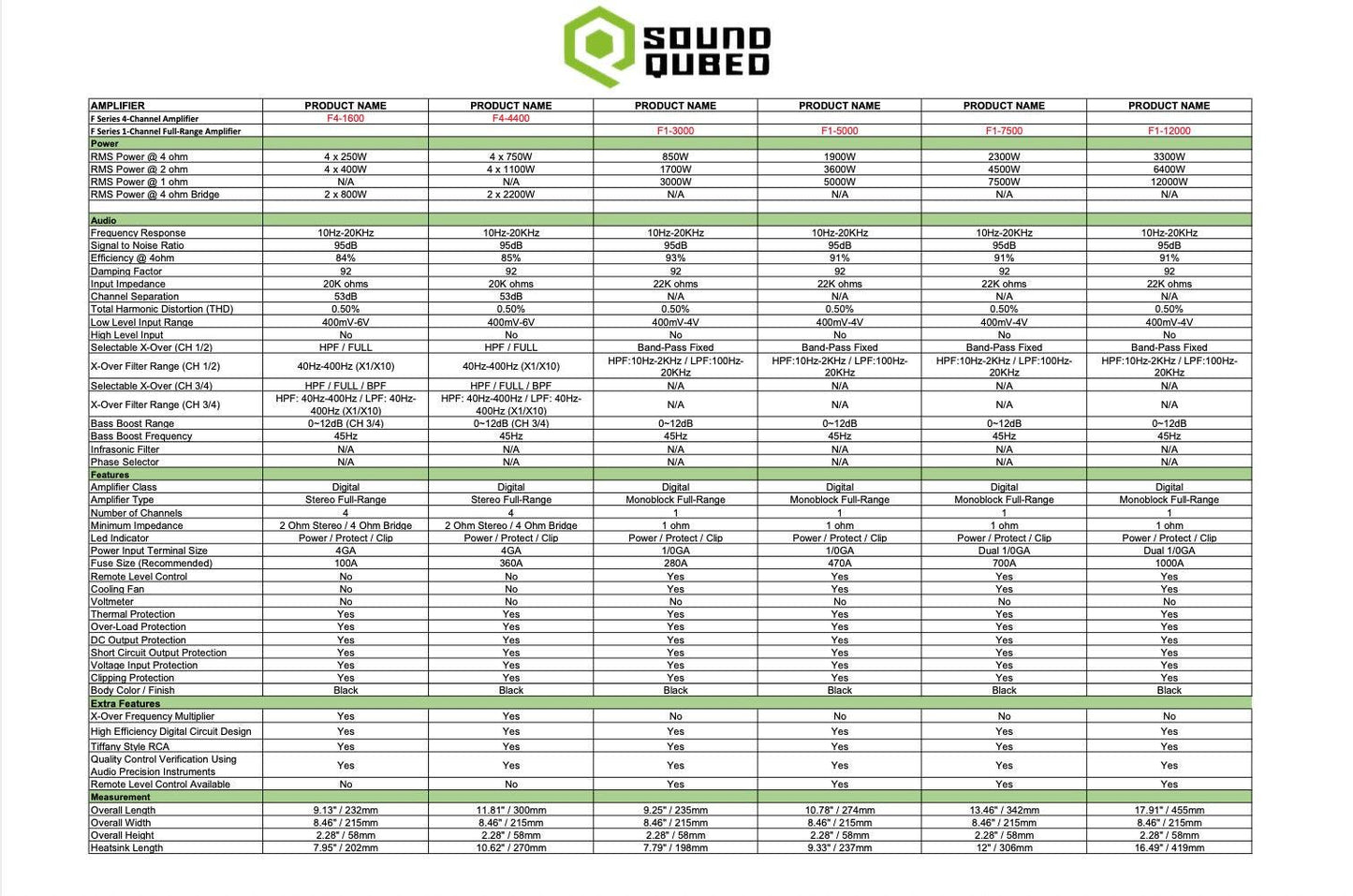
The SoundQubed F4-4400 full-bridge 4-channel amplifier delivers extreme multi-channel power for serious mids, highs, midbass speakers, pro-audio doors, custom speaker pods and high-output full-range car audio systems. Rated for up to 1,100 watts RMS across four channels at 2 ohms, this is not a basic factory-speaker amplifier. It is designed for systems that need powerful speaker output capable of keeping up with a large subwoofer stage.
The F4-4400 can also produce 750 watts RMS x 4 at 4 ohms or be bridged to deliver 2,200 watts RMS x 2 at 4 ohms. That gives experienced installers several ways to configure the amplifier around compatible speakers, impedance loads and system goals.
Despite its serious output, the SoundQubed F4-4400 uses a relatively compact full-bridge design measuring approximately 11.81" long, 8.46" wide and 2.28" tall. This helps installers build high-power mids-and-highs systems without requiring the footprint normally associated with several separate amplifiers.
Audio Sellerz started selling SoundQubed in 2024, and we quickly realized we should have carried the brand sooner. The F4-4400 is a strong example of what makes the lineup useful: major full-range power, flexible channel configurations and a compact chassis for serious car audio builds.
SoundQubed F4-4400 RMS Power Ratings
- RMS power at 4 ohms: 750 watts x 4 channels
- RMS power at 2 ohms: 1,100 watts x 4 channels
- Bridged RMS power at 4 ohms: 2,200 watts x 2 channels
- Total rated output: Up to 4,400 watts RMS
- Frequency capability: 10Hz–20kHz
- Dimensions: 11.81" long x 8.46" wide x 2.28" tall
- Amplifier type: Full-bridge 4-channel amplifier
High-Power 4-Channel Amplifier for Serious Mids and Highs
The SoundQubed F4-4400 4-channel amplifier is built for customers whose speaker system needs considerably more power than a radio, small four-channel amp or normal daily-driver speaker amplifier can provide.
This amplifier can be used in properly planned systems powering equipment such as:
- High-power midrange speakers
- Large pro-audio door speakers
- Midbass speakers
- Full-range loudspeakers
- Custom speaker pods
- Large custom door panels
- Demo-style mids-and-highs systems
- Speakers that need to keep up with multiple high-power subwoofers
- Two compatible high-power loads using the bridged configuration
This level of output is far beyond what most factory-replacement coaxial speakers can handle. The F4-4400 should be matched with speakers that have verified RMS ratings, impedance and frequency ranges appropriate for the amplifier’s available power.
Browse the dedicated SoundQubed amplifier collection to compare the F4-4400 with other SoundQubed full-bridge, monoblock and multi-channel amplifiers.
750 Watts x 4 at 4 Ohms
At 4 ohms, the SoundQubed F4-4400 produces 750 watts RMS through each of four channels.
This configuration can work well for four compatible 4-ohm speaker loads that can safely handle the available power. It gives each channel independent output while providing considerably more power than most standard four-channel car audio amplifiers.
A 4-ohm configuration may be useful when:
- Each channel is powering one high-power 4-ohm speaker
- The system is designed around four separate speaker zones
- The installer wants independent channel control
- The connected speakers require substantial RMS power
- The system needs strong full-range output without dropping each channel to 2 ohms
Do not assume every 4-ohm speaker can safely handle 750 watts RMS. Verify the speaker’s real RMS rating and intended frequency range before connecting it.
1,100 Watts x 4 at 2 Ohms
At 2 ohms, the F4-4400 is rated for an enormous 1,100 watts RMS per channel.
This configuration is aimed at high-output speaker systems that need major power across four channels. A 2-ohm channel load may be created by one compatible 2-ohm speaker or by multiple speakers wired together correctly.
Before wiring multiple speakers to an amplifier channel, calculate the final impedance carefully. The connected load should not fall below the amplifier’s rated 2-ohm stereo capability.
A lower-than-rated impedance can cause:
- Excessive heat
- Amplifier protect mode
- Blown fuses
- Voltage drop
- Clipping or distorted output
- Premature amplifier failure
Every speaker connected to the channel must also receive an appropriate share of the available power. Do not wire several low-power speakers together simply to create a 2-ohm load without calculating how the amplifier’s output will be distributed.
2,200 Watts x 2 Bridged at 4 Ohms
The SoundQubed F4-4400 can be bridged to produce 2,200 watts RMS x 2 at 4 ohms.
Bridging combines pairs of channels to provide substantially more power through two outputs. This can make sense for experienced installers powering two compatible high-power 4-ohm loads.
When using the bridged configuration:
- Use only the correct bridged speaker terminals
- Keep each bridged load at the rated 4-ohm impedance
- Verify that the connected equipment can safely handle 2,200 watts RMS
- Set the correct high-pass or low-pass crossover for the connected speakers
- Set amplifier gain with a proper method
- Provide adequate electrical support and airflow
Do not connect a bridged load below 4 ohms. A load that is safe in normal stereo operation may not be safe when the channels are bridged.
4400-Watt 4-Channel Amp for Pro-Audio Doors
The SoundQubed F4-4400 mids-and-highs amplifier can become the power foundation for a serious custom door build.
High-output doors may include:
- Multiple midrange speakers
- High-power midbass drivers
- Full-range pro-audio speakers
- Tweeters or horns on separately protected channels
- Custom speaker pods
- Large fabricated door panels
A loud door build should be planned as a complete speaker system. The installer needs to consider speaker impedance, power handling, frequency response, crossover points, channel assignments and how every speaker will work together.
More amplifier power does not automatically create a better-sounding system. The F4-4400 needs properly selected speakers and careful tuning to produce strong, clean output without damaging equipment.
Compare available car audio speakers, midranges and full-range speakers before planning the final amplifier configuration.
Can the SoundQubed F4-4400 Power Tweeters?
The amplifier has full-range frequency capability, but its enormous output means tweeter systems must be planned extremely carefully.
Tweeters normally require:
- A properly set high-pass crossover
- Correct crossover slope
- Power matched to the tweeter’s verified RMS rating
- Correct impedance per channel
- Careful gain setting
- Protection from clipping and excessive equalizer boost
Do not connect a small tweeter directly to a channel capable of producing hundreds or thousands of watts without a properly designed system. The F4-4400 is more commonly suited to high-power mids, midbass and full-range speakers, with tweeters powered and protected according to the complete speaker layout.
Compact Full-Bridge Amplifier Design
The F4-4400 measures approximately 11.81" long x 8.46" wide x 2.28" tall.
Its full-bridge design allows SoundQubed to package serious multi-channel output into a chassis that is easier to fit into an amp rack than several large conventional amplifiers.
The compact footprint can help in:
- Pickup trucks
- Compact cars
- Hatchbacks
- Multi-amplifier systems
- Custom amp racks
- Demo vehicles
- Speaker builds where mounting room is limited
The smaller chassis does not remove the need for airflow. Mount the amplifier securely and leave adequate room around it for heat to escape.
Avoid installing the F4-4400:
- Under loose carpet
- Inside a sealed compartment with no ventilation
- Against soft material that blocks the heat sink
- Where water or condensation can reach it
- Where cargo can damage the terminals or wiring
- Where seat tracks or moving parts can contact it
Full-Range 10Hz–20kHz Frequency Capability
The SoundQubed F4-4400 has a listed frequency capability from 10Hz to 20kHz.
This allows it to be used as a full-range amplifier when the connected equipment and crossover settings are appropriate.
Possible applications include:
- Midrange speakers
- Midbass speakers
- Full-range loudspeakers
- Pro-audio door speakers
- High-output custom speaker systems
- Compatible bridged speaker configurations
The fact that the amplifier can reproduce a wide frequency range does not mean every connected speaker should be played full range.
Midrange speakers, midbass drivers, tweeters and horns each need crossover protection based on their actual specifications.
Who Should Buy the SoundQubed F4-4400?
The SoundQubed F4-4400 may be a strong choice for customers building:
- A very high-power four-channel speaker system
- Large pro-audio front and rear doors
- A demo vehicle with serious mids and highs
- A custom speaker-pod system
- A full-range system that needs to keep up with major bass output
- A bridged two-channel system using compatible 4-ohm loads
- A compact amp rack that still requires thousands of watts of speaker power
- A complete SoundQubed amplifier and speaker build
This amplifier is probably more power than a basic factory-replacement speaker system needs.
Customers needing less output should compare the F4-4400 with other 4-channel car audio amplifiers for door speakers, mids and highs.
Match the F4-4400 With the Correct Speakers
The F4-4400 should be matched to speakers using real system information—not only the largest wattage number printed on a product page.
Before connecting speakers, verify:
- The speaker’s RMS power handling
- The impedance of each speaker
- The final impedance connected to each channel
- The number of speakers per channel
- The speaker’s usable frequency range
- The required crossover point
- Whether the amplifier will run stereo or bridged
- How the power will be divided among multiple speakers
A speaker rated for a few hundred watts RMS should not automatically be connected to a channel capable of producing 1,100 watts RMS without carefully limiting clean output through proper gain setting.
Likewise, an amplifier should not be driven into clipping simply because the connected speaker system is rated for more power.
Set Crossovers for the Connected Speakers
Proper crossover settings help protect the speakers from frequencies they are not designed to reproduce.
For example:
- Midrange speakers normally need a high-pass filter
- Midbass drivers may use both high-pass and low-pass filtering
- Tweeters require protection from lower frequencies
- Full-range speakers still need settings appropriate for their size and installation
- Bridged equipment should be crossed according to its intended use
Do not guess at crossover settings. Use the connected speaker specifications, the installation and the desired system response to determine the correct starting point.
Set Amplifier Gain Correctly
The F4-4400 gain controls are not volume knobs.
Gain is used to match the amplifier’s input sensitivity to the signal coming from the radio, DSP or other source.
Setting gain too high can cause:
- Clipping
- Distortion
- Overheated speakers
- Burned voice coils
- Harsh mids and highs
- Premature amplifier or speaker failure
Read the Audio Sellerz guide to setting amplifier gain for mids and highs before tuning the completed system.
Power Wire, Ground Wire and Fuse Protection
A 4,400-watt 4-channel amplifier can create serious electrical demand.
The F4-4400 installation needs:
- Power wire sized for the complete current demand
- A matching ground-wire capacity
- A short and secure amplifier ground
- Correct battery-side fuse protection
- High-quality terminals and connections
- Safe power-wire routing
- A charging system capable of supporting the amplifier
Do not assume that a basic amplifier wiring kit is enough simply because the cable fits into the amplifier terminal.
The correct wire size depends on:
- Amplifier current demand
- Charging voltage
- Power-wire length
- OFC or CCA construction
- Whether additional amplifiers share the electrical system
- Future system upgrades
Shop available car audio amp kits and amplifier wiring for the supporting installation equipment.
Use the car audio wire gauge chart and fuse guide to understand how amplifier power, cable length, wire material and fuse protection work together.
Build a Proper F4-4400 Amplifier Ground
The ground cable is part of the same electrical circuit as the positive power cable.
A large positive cable cannot make up for a weak, undersized or poorly connected ground.
The F4-4400 amplifier ground should be:
- As short as practical
- Connected to clean bare metal
- Secured against vibration
- Protected from corrosion
- Large enough for the amplifier’s current demand
- Tested for excessive resistance or voltage drop
A poor ground can cause:
- Weak amplifier output
- Excessive heat
- Protect mode
- Voltage instability
- Noise
- Damaged terminals or wiring
Read the car audio grounding guide for building a better amplifier ground.
Does the SoundQubed F4-4400 Need Electrical Upgrades?
A high-output amplifier like the F4-4400 should be planned around the complete vehicle electrical system.
The amount of support needed depends on:
- How much power the amplifier is actually producing
- The connected speaker loads
- How long and how hard the system will be played
- Whether a monoblock subwoofer amplifier is also installed
- The health of the factory battery and alternator
- The existing power and ground wiring
- The vehicle’s charging voltage
Possible electrical upgrades may include:
- A Big 3 wiring upgrade
- Larger charging and grounding cables
- Additional battery capacity
- A high-output alternator
- Upgraded fuse holders and power distribution
- Multiple power and ground runs when required
Review the step-by-step car audio electrical upgrade guide before completing a high-power F4-4400 system.
Using the F4-4400 With a Monoblock Subwoofer Amplifier
One of the most common ways to build a serious car audio system is to use:
- A 4-channel amplifier for mids, highs and door speakers
- A monoblock amplifier for subwoofers
The SoundQubed F4-4400 can provide the speaker-side power needed to keep vocals, instruments and high frequencies present when a large subwoofer system is playing.
However, running the F4-4400 alongside a powerful monoblock creates substantial combined electrical demand.
The alternator, batteries, wiring, fuse protection and power distribution need to be designed around both amplifiers—not only one of them.
Why Buy the SoundQubed F4-4400 From Audio Sellerz?
Audio Sellerz is a real brick-and-mortar car audio shop in Norton, Ohio.
We understand that choosing a high-power four-channel amplifier involves more than finding the largest number available.
The amplifier must work with:
- The speakers
- The final impedance
- The crossovers
- The input signal
- The gain settings
- The power and ground wire
- The fuse protection
- The battery and alternator
When you buy the SoundQubed F4-4400 from Audio Sellerz, you are purchasing from people who understand loud mids and highs, custom doors, multi-amplifier systems and serious high-output car audio builds.
Learn more about our relationship with the brand in the article explaining why Audio Sellerz sells and supports SoundQubed.
SoundQubed F4-4400 Frequently Asked Questions
How much power does the SoundQubed F4-4400 make?
The F4-4400 is rated for 750 watts RMS x 4 at 4 ohms, 1,100 watts RMS x 4 at 2 ohms and 2,200 watts RMS x 2 when bridged at 4 ohms.
Is the SoundQubed F4-4400 a full-bridge amplifier?
Yes. The F4-4400 is part of SoundQubed’s F-Series full-bridge amplifier lineup.
Is the F4-4400 stable at 2 ohms?
The amplifier is rated to produce 1,100 watts RMS through each of its four channels at 2 ohms.
Can the SoundQubed F4-4400 be bridged?
Yes. It is rated for 2,200 watts RMS x 2 when bridged at 4 ohms. Do not connect a bridged load below the rated 4-ohm impedance.
Can the F4-4400 power mids and highs?
Yes. Its listed 10Hz–20kHz frequency capability allows it to power compatible full-range speakers, mids and highs when the amplifier, crossover settings and power levels are matched correctly.
Can the F4-4400 power normal factory-replacement speakers?
The amplifier has far more power than most normal factory-replacement speakers can safely handle. It is better suited to high-power speakers, pro-audio equipment and properly planned custom systems.
How large is the SoundQubed F4-4400?
The amplifier measures approximately 11.81" long x 8.46" wide x 2.28" tall.
What speakers should I use with the F4-4400?
Choose speakers according to their verified RMS power handling, impedance, frequency range and the number of speakers wired to each channel. The correct setup depends on whether the amplifier is running at 4 ohms, 2 ohms or bridged at 4 ohms.
What amp kit should I use with the F4-4400?
The correct wiring depends on current demand, cable length, conductor material, charging voltage and whether additional amplifiers are installed. Size the power wire, ground wire and fuse protection for the complete system rather than choosing a kit by price alone.
Does the F4-4400 need a high-output alternator?
Electrical requirements depend on how the amplifier is used and what other equipment is installed. A high-output system using the F4-4400 at substantial power may require stronger wiring, additional battery capacity and a high-output alternator.
Match This SoundQubed Amplifier to the System
Use the continuous power ratings at the intended impedance, minimum stable load, channel configuration, crossover controls, input signal, fuse requirements, power-wire size, ground path, ventilation, and vehicle electrical support. This amplifier should be matched to speakers, mids, highs, component sets, or custom doors according to the original specifications.
Shop SoundQubed Amplifiers and Supporting Products
Compare the complete SoundQubed amplifier collection, browse more 4-channel car audio amplifiers, and review the SoundQubed SK1 F-Series bass knob and monitor when the exact amplifier supports it.
Helpful SoundQubed Amplifier Guides
Compare the models in the SoundQubed F-Series amplifier guide. Use the guide to wiring an amplifier to the correct ohm load, verify power wire and fusing with the car audio wire-gauge and fuse guide, and create a dependable return path with the amplifier grounding guide.
Set the system up with the amplifier gain guide for subs, mids, and highs. If the amp shuts down, use the amplifier protect-mode troubleshooting guide before replacing equipment by guesswork.
Shop SoundQubed at Audio Sellerz
Browse the complete SoundQubed car audio collection at Audio Sellerz for SoundQubed subwoofers, amplifiers, speakers, tweeters, wiring, deadener, and system accessories. Read why Audio Sellerz sells and supports SoundQubed to learn more about the brand relationship and the product categories we carry.
Frequently Asked Questions About SoundQubed 4400 Watt F4-4400 Full Bridge 4 Channel Amplifier
What should this SoundQubed amplifier power?
Match the amplifier channel layout, RMS output, impedance ratings, and crossover controls to the connected speakers or subwoofers. Confirm the complete model specifications before ordering.
What power wire and fuse does it need?
Use the amplifier's published current and fuse requirements, total power-wire length, conductor material, installation temperature, and electrical-system design. Do not choose wire from the model name alone.
Does a larger amplifier require electrical upgrades?
It may. Measure voltage under load and evaluate the power wire, ground, fuse holder, battery reserve, Big 3 wiring, and alternator output as one electrical system.
Follow Audio Sellerz
Stay connected with Audio Sellerz for new products, car audio builds, install videos, demos, and updates:
Follow Audio Sellerz on Facebook
Follow Audio Sellerz on Instagram
Follow Audio Sellerz on TikTok
Subscribe to Audio Sellerz on YouTube
Share