SoundQubed Deadener
-
SoundQubed 80 Mil Sound Deadener 36 Sq Ft 20 Sheets
Vendor:SoundQubedRegular price $114.95 USDRegular price

-
 SoundQubed 80 Mil Sound Deadener 36 Sq Ft 20 SheetsSoundQubed 80 Mil Sound Deadener 36 Sq Ft 20 Sheets Sold by AudioSellerz.com The SoundQubed 80 Mil Sound Deadener 36 ...$114.95

SoundQubed Sound Deadener & Q-MAT for Quieter, Cleaner Car Audio Systems
Sold by AudioSellerz.com
SoundQubed sound deadener helps control panel vibration, reduce rattles, and lower unwanted road noise inside your vehicle. Whether you are upgrading factory door speakers, installing a powerful subwoofer system, or treating an entire vehicle, SoundQubed deadener can help create a quieter and more controlled environment for your car audio equipment.
This collection brings together available SoundQubed Q-MAT and automotive sound-deadening material for doors, trunks, floors, roofs, rear decks, hatch areas, cargo areas, and other metal panels that can vibrate when music is playing.
Audio Sellerz started selling SoundQubed in 2024, and we quickly realized we should have carried the brand sooner. SoundQubed offers more than subwoofers, amplifiers, and speakers. Its sound-deadening products help customers improve the vehicle around the audio system so the equipment can perform in a more stable environment.
Start here:
shop the complete SoundQubed collection |
shop SoundQubed subwoofers |
shop SoundQubed speakers |
shop all car audio subwoofers |
shop all car audio speakers
What Does Car Audio Sound Deadener Do?
Car audio sound deadener is applied to vehicle panels to reduce resonance and vibration. Vehicle doors, trunk lids, roofs, floors, rear decks, hatch panels, and quarter panels are made from metal that can vibrate when exposed to road noise, engine noise, speaker movement, and subwoofer pressure.
Those vibrations can create:
- Buzzing door panels
- Trunk and hatch rattles
- License plate vibration
- Thin or hollow-sounding midbass
- Road and tire noise
- Roof movement during heavy bass
- Rear-deck resonance
- Interior trim noise
- Unwanted sound outside the vehicle
Butyl sound-deadening material adds mass and damping to these surfaces. This helps limit how easily the panels move and resonate.
Sound deadener does not create more amplifier power or increase a speaker’s RMS rating. Instead, it improves the environment in which the audio system operates by reducing unwanted panel movement and noise.
Shop SoundQubed Q-MAT Sound Deadener
SoundQubed Q-MAT is a flexible, self-adhesive butyl sound-deadening material backed with an aluminum top layer. It is a good option for targeted treatment areas where you want to control vibration around speakers, subwoofers, doors, trunks, hatch panels, and other problem spots.
The SoundQubed Q-MAT package provides approximately:
- 75 mil total thickness
- Approximately 2 mm thickness
- 16 square feet of coverage
- Eight individual sheets
- Flexible butyl construction
- Self-adhesive backing
- Silver aluminum top layer
The flexible construction allows Q-MAT to follow the curves and contours found inside doors, trunks, floors, rear decks, hatch panels, and other vehicle panels. Because it uses a self-adhesive butyl layer, no separate spray adhesive is required. The surface still needs to be cleaned and prepared correctly before installation.
A package of SoundQubed Q-MAT can be useful for targeted treatment of:
- Front doors
- Rear doors
- Speaker mounting areas
- Trunk lids
- Rear decks
- Hatch panels
- Spare-tire wells
- Small cargo areas
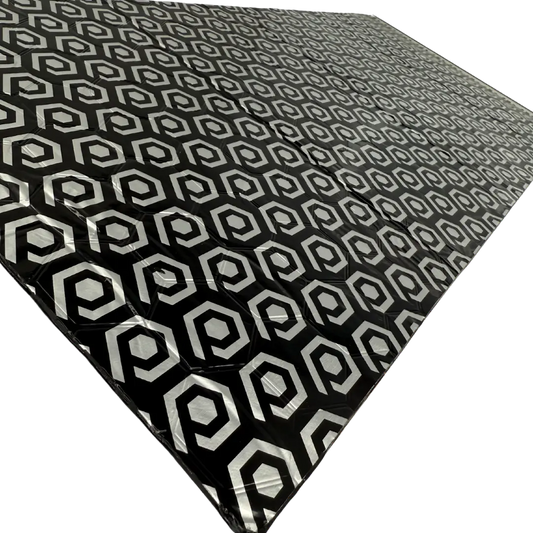
SoundQubed 80 Mil Sound Deadener
SoundQubed 80 mil sound deadener provides a larger coverage option for customers treating several areas or working on a more complete vehicle installation.
The SoundQubed 80 mil package includes:
- 80 mil sound-deadening material
- Approximately 36 square feet of total coverage
- 20 individual sheets
- Self-adhesive automotive application
- Butyl-based vibration control
- Embossed hexagon texture
- SoundQubed Q branding on the sheets
Thirty-six square feet gives installers more material for doors, trunks, floors, rear cargo areas, hatch areas, and other problem panels. The individual sheets can be trimmed around factory wiring, braces, access openings, seat mounts, and interior components. Measure the planned installation areas before ordering and allow extra material for trimming and overlap.
SoundQubed Deadener for Car Doors
Doors are one of the most useful places to install SoundQubed door deadener. A factory door is a large metal structure with openings, braces, wiring, window mechanisms, and interior trim. When a speaker is mounted in that environment, part of its energy can be lost through panel movement and vibration.
Adding deadener to the door can help:
- Reduce outer door-skin vibration
- Control resonance around the speaker opening
- Reduce door-panel buzzing
- Improve the stability of the speaker mounting area
- Create cleaner midbass response
- Lower some outside road noise
- Help upgraded speakers sound more controlled
Customers planning a door upgrade can compare additional car audio speakers for factory and custom door installations.
Sound deadener should be installed carefully around window tracks, wiring harnesses, drainage openings, door-lock cables, and moving parts. Do not block factory drains at the bottom of the door.
Sound Deadener for Midbass and Door Speakers
A good midbass speaker needs a stable mounting surface. When the metal surrounding the speaker moves excessively, some of the speaker’s energy is transferred into the door instead of being used to produce controlled sound inside the vehicle.
SoundQubed deadener can help reinforce the area around:
- Factory speaker openings
- Aftermarket speaker adapters
- Custom door pods
- 6.5" speaker locations
- 6x9" speaker locations
- Midrange speaker installations
- Midbass speaker installations
Deadener will not repair a loose speaker mount or replace a proper adapter. The speaker should still be bolted securely, wired correctly, and protected from moisture inside the door.
Build the speaker side here:
shop car audio midbass speakers |
shop car audio midrange speakers |
shop full range car audio speakers
SoundQubed Deadener for Trunks and Subwoofer Systems
A powerful subwoofer system can expose every weak or loose panel in the rear of a vehicle. Trunk lids, rear decks, taillight areas, license plates, quarter panels, hatch panels, and interior trim may begin to vibrate as pressure increases.
Installing SoundQubed trunk sound deadener can help control:
- Trunk-lid vibration
- Rear-deck resonance
- Quarter-panel movement
- License plate buzzing
- Spare-tire-well resonance
- Loose trim noise
- Hatch and liftgate vibration
The louder the bass system becomes, the more important panel preparation can be. A large amplifier and multiple subwoofers may produce enough pressure to make untreated sheet metal and trim extremely noticeable.
Customers planning a bass build can compare available car audio subwoofers for daily-driver and high-output systems.
Sound deadener can reduce resonance, but it may not eliminate every rattle. Loose clips, license plate hardware, taillights, vents, wiring, and interior trim may need to be secured separately.
SoundQubed Deadener for Hatchbacks and SUVs
Hatchbacks and SUVs often have large rear panels and cargo areas that can become noisy when subwoofers are installed. SoundQubed deadener can help control vibration in the rear of the vehicle when the bass system starts moving more air.
Useful treatment areas may include:
- Rear hatch metal
- Interior hatch trim
- Rear quarter panels
- Cargo floor
- Spare-tire well
- Rear wheel-well areas
- Roof panels
- License plate mounting area
Hatch and liftgate trim should be removed carefully because factory clips can become brittle or loose. Any loose trim should be repaired before the panels are reassembled.
SoundQubed Deadener for Vehicle Floors
Installing automotive sound deadener on the floor can help reduce vibration and some noise transmitted through the lower body of the vehicle.
Floor treatment may be useful for reducing:
- Tire noise
- Drivetrain vibration
- Exhaust resonance
- Road noise
- Floor-panel vibration
Treating a complete floor normally requires more material and considerably more disassembly than treating doors or a trunk. Seats, trim panels, carpet, and the center console may need to be removed. Always protect factory wiring, airbag connectors, seat wiring, and vehicle electronics during the installation.
SoundQubed Deadener for Roof Panels
A large roof panel can flex when exposed to strong bass. This is especially noticeable in SUVs, vans, hatchbacks, and vehicles with large flat roof areas.
Roof deadening can help reduce:
- Roof-panel resonance
- Metallic ringing
- Vibration caused by subwoofer pressure
- Some rain noise
- Noise from loose headliner components
Roof installations require care. The material must be adhered securely so it does not separate above the headliner. Avoid covering curtain airbags, airbag paths, wiring, roof drains, or sunroof mechanisms.
Sound Deadener vs Car Soundproofing
Sound deadening and complete vehicle soundproofing are related, but they are not exactly the same thing.
Butyl sound deadener primarily helps control vibration and resonance in metal panels. It can also reduce some noise, but it does not turn a vehicle into a completely silent space.
A more complete sound-control system may use several types of material:
- Butyl deadener to reduce panel vibration
- Closed-cell foam to help separate panels and trim
- Absorbing material for cavities
- Barrier material to block airborne noise
- Fabric tape or foam for wiring and trim rattles
SoundQubed deadener is an important foundation, but customers should have realistic expectations. It can make a noticeable improvement without eliminating every sound produced by the road, tires, engine, or audio system.
75 Mil vs 80 Mil Sound Deadener
Both 75 mil and 80 mil SoundQubed deadener are designed to add damping to vehicle panels. The difference between those thicknesses is relatively small. Coverage area, installation location, surface preparation, and how firmly the material is rolled onto the panel can matter just as much as the nominal thickness.
SoundQubed Q-MAT provides a smaller 16-square-foot package that can work well for targeted areas. The 80 mil package provides approximately 36 square feet for customers treating several doors, a trunk, a cargo area, or a larger portion of the vehicle.
Choose based on:
- The total area being treated
- The number of doors
- Whether the trunk or cargo area is included
- Whether the floor or roof will be treated
- The severity of the existing vibration
- The amount of trimming and waste expected
How Much Sound Deadener Do You Need?
The amount of SoundQubed deadener needed depends on the vehicle, installation areas, and desired level of coverage.
Before ordering:
- Decide which panels you plan to treat.
- Measure the approximate length and width of each area.
- Add the measurements together.
- Allow extra material for curves, braces, and trimming.
- Round up instead of ordering the exact calculated amount.
A small package may be enough for one or two targeted areas. Treating four doors, a trunk, floor, and roof can require several packages.
Complete coverage is not always necessary for a noticeable improvement. Strategic coverage on the largest vibrating areas can still help, especially when the material is installed correctly.
How to Install SoundQubed Sound Deadener
Proper installation is important for long-term adhesion and effective vibration control.
- Remove the interior panel, carpet, or trim covering the installation area.
- Identify wiring, braces, drains, airbag components, and moving mechanisms.
- Clean the metal surface thoroughly.
- Remove dust, oil, grease, wax, and loose factory material.
- Measure and cut the SoundQubed deadener to fit.
- Warm the material and surface when needed for better flexibility and adhesion.
- Peel away the backing gradually.
- Press the butyl side firmly against the metal.
- Use a roller to remove air pockets and create full contact.
- Check that no drainage holes, wiring, or moving parts are blocked.
- Reinstall the factory interior carefully.
Do not apply deadener over dirty, wet, greasy, or loose surfaces. The adhesive can only hold as well as the surface beneath it.
Common Sound Deadener Installation Mistakes
Avoid these common problems when installing SoundQubed Q-MAT or other automotive deadener:
- Applying material over dust or grease
- Failing to roll the material firmly
- Leaving large air pockets
- Covering door drainage holes
- Interfering with window mechanisms
- Covering airbag components or deployment paths
- Applying deadener over rust
- Blocking factory access openings that may be needed later
- Covering electrical ground locations
- Using deadener to hide loose hardware instead of repairing it
- Reinstalling broken trim clips
- Expecting one small sheet to completely soundproof the vehicle
Never place an amplifier ground terminal over sound deadener. Electrical grounds need clean, bare metal contact.
Does Sound Deadener Make Bass Louder?
Sound deadener does not increase amplifier wattage or change the subwoofer’s power rating. However, reducing panel resonance and unwanted rattles can make the bass sound cleaner and more controlled. Less energy may be lost through vibrating panels, and distracting noise can become less noticeable.
The result can be a system that sounds more solid even though the electrical power has not changed.
Does Sound Deadener Improve Door Speakers?
It can help, especially when the door metal and speaker mounting area are vibrating.
Better panel control can support:
- Cleaner midbass
- Reduced door buzz
- A more stable speaker mount
- Less sound escaping into the door cavity
- Better separation between the front and rear of the speaker
The final result still depends on the speakers, amplifier, crossover settings, installation, and condition of the door.
Helpful Audio Sellerz Links
Build the rest of the system here:
shop all SoundQubed car audio products |
shop car audio subwoofers |
shop car audio speakers |
shop car audio amplifiers |
shop car audio wire
Helpful guides:
read the car audio grounding guide |
read the car audio wire gauge and fuse guide |
read the speaker performance and T/S parameter guide
Why Buy SoundQubed Deadener From Audio Sellerz?
Audio Sellerz is a real brick-and-mortar car audio shop in Norton, Ohio. We understand that a complete car audio system involves more than amplifiers and subwoofers. The vehicle itself affects how the system sounds.
Doors, trunks, roofs, floors, hatch panels, and interior panels can all vibrate. Adding the correct sound-deadening material can help control those surfaces and support a cleaner finished installation.
When you shop SoundQubed deadener at Audio Sellerz, you are buying from people who understand factory speaker upgrades, custom doors, daily-driver bass systems, high-output builds, and the supporting products needed to make a system perform better in the real world.
Browse the complete SoundQubed car audio collection at Audio Sellerz to shop SoundQubed deadener, subwoofers, amplifiers, speakers, wiring, and related equipment.
Frequently Asked Questions About SoundQubed Deadener
What is SoundQubed Q-MAT?
SoundQubed Q-MAT is a self-adhesive butyl sound-deadening material with an aluminum top layer. It is designed to reduce panel vibration, resonance, and unwanted vehicle noise.
How thick is SoundQubed Q-MAT?
SoundQubed Q-MAT is listed at approximately 75 mil, or about 2 mm thick.
How much area does SoundQubed Q-MAT cover?
The Q-MAT package provides approximately 16 square feet of coverage across eight sheets.
Does SoundQubed offer 80 mil deadener?
Yes. SoundQubed offers an 80 mil sound-deadener package providing approximately 36 square feet of coverage across 20 sheets.
Where should I install SoundQubed deadener?
Common installation areas include doors, trunks, rear decks, hatch panels, cargo floors, spare-tire wells, roofs, and other metal surfaces that vibrate.
Will sound deadener stop every rattle?
No. Sound deadener can reduce panel resonance, but loose trim, clips, license plates, wiring, and hardware may still need to be repaired or secured separately.
Does deadener make a subwoofer louder?
It does not add amplifier power, but reducing vibration and rattles can make the bass sound cleaner and more controlled.
Can I install SoundQubed deadener inside car doors?
Yes. Doors are a common installation area. Avoid blocking drains, wiring, window tracks, lock cables, and moving mechanisms.
Do I need a roller to install SoundQubed deadener?
A roller is strongly recommended because it helps press the material firmly against the panel and reduces trapped air.
Can I install deadener over paint?
Factory-painted interior metal can normally be treated after it is cleaned properly. Do not apply deadener over loose paint, rust, grease, moisture, or damaged coatings.
Is SoundQubed deadener the same as complete soundproofing?
No. Butyl deadener primarily controls vibration and resonance. Complete soundproofing may also require foam, absorbers, barriers, and treatment of multiple areas.
Follow Audio Sellerz
Follow Audio Sellerz for SoundQubed deadener, car audio installations, speaker upgrades, subwoofer builds, product videos, and new equipment:
Facebook |
Instagram |
TikTok |
YouTube